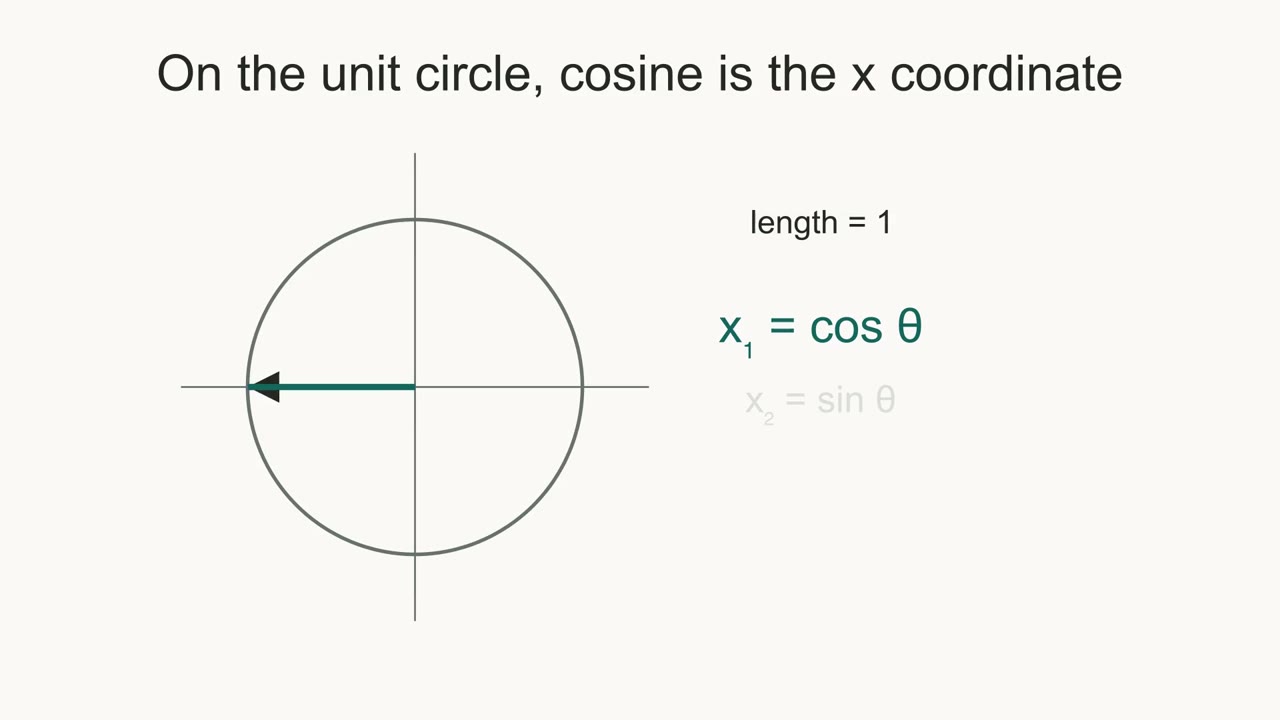
Cosine is a horizontal coordinate
Picture an arrow of length one rotating around the origin. Its tip traces the unit circle. Measure the angle from the positive horizontal axis. The tip has coordinates
Cosine is the horizontal coordinate of that moving point. At zero degrees the arrow points entirely right, so cosine is 1. At a quarter turn it points upward, so cosine is 0. At a half turn it points left, so cosine is .
Stretch the arrow
If the arrow has length instead of one, multiply both coordinates by :
Its horizontal component is therefore . Think of this as its signed shadow on the horizontal axis: rightward is positive, leftward is negative.
Turn this into a dot product
Now place a second vector along that horizontal direction. If has length and the rotating vector has length , their dot product is
The factor measures how much of lies along . The remaining factor scales that amount. We could rotate the coordinate axes with both vectors and the angle between them would stay the same.
Predict before calculating
Two nonzero vectors meet at a right angle. What is their dot product?
Answer: Zero. Neither has a component along the other's direction, and .