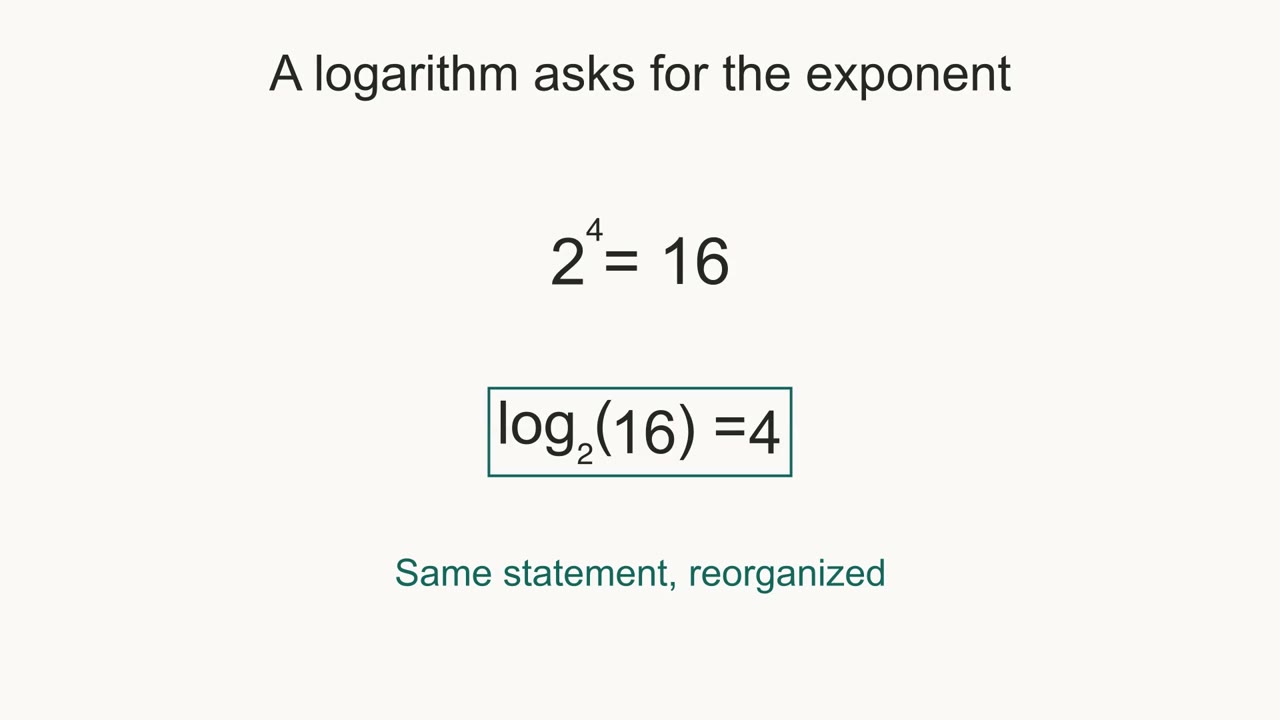
Count multiplicative steps
Starting from 1, double four times:
Exponentiation asks where those steps take us: . A logarithm asks how many steps we took: .
Read the notation in both directions
The base specifies the multiplication factor. For real logarithms, the input satisfies , and the base satisfies , .
The step count can be fractional or negative. Half a base-4 step takes 1 to 2, since . One backward base-2 step takes 1 to , so .
Multiplying outputs adds their step counts
Eight is three doublings from 1; four is two doublings. Multiplying them gives 32, which is five doublings:
For positive , the general rule is . This follows from adding exponents when multiplying powers with the same base.
Use the scale
On a base-10 logarithmic scale, moving one unit means multiplying the original quantity by 10. Equal steps on the log axis represent equal ratios, not equal differences. That makes such scales useful for comparing very different magnitudes.
What is ?
Answer: , because three backward factors of 10 take 1 to .