Separate size from direction
The geometric dot-product formula has three ingredients:
Two lengths tell us the scale. The cosine tells us their alignment. Keeping those roles separate makes it easier to predict an answer before doing arithmetic.
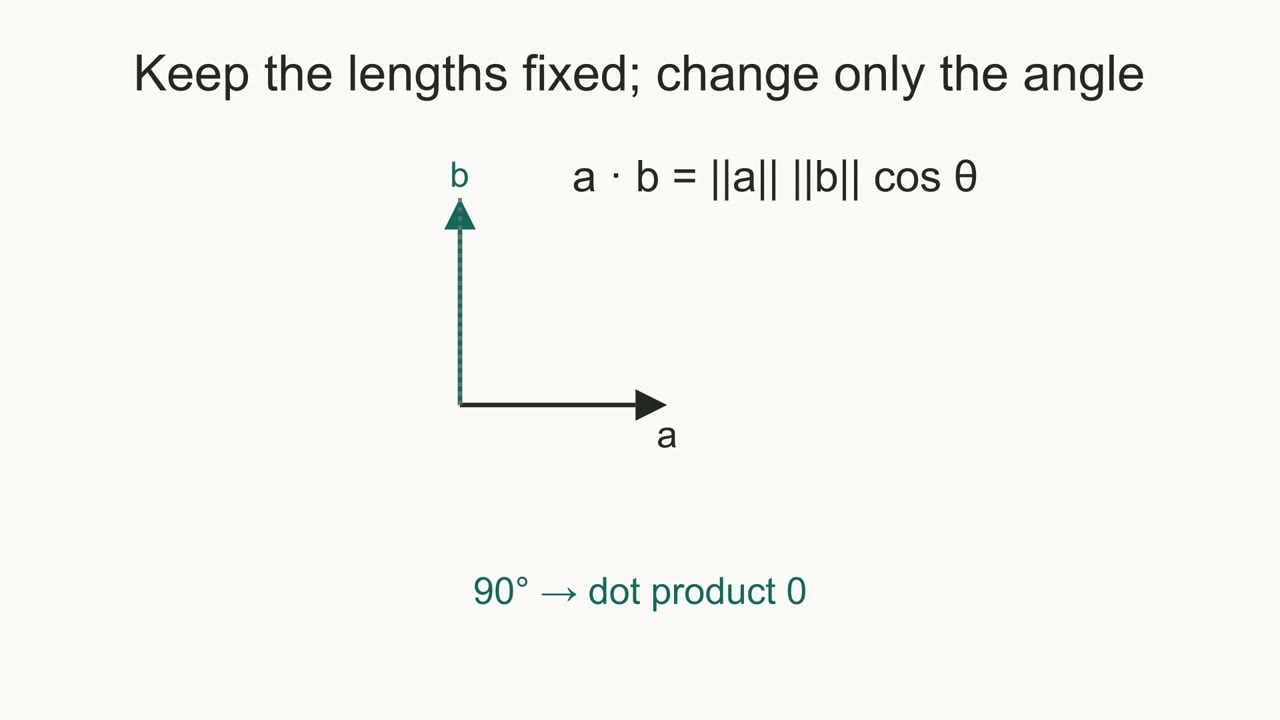
Rotate while holding the lengths fixed
Take vectors of lengths 3 and 2. Their dot product is .
- Same direction: , so the result is 6.
- A right angle: , so the result is 0.
- Opposite directions: , so the result is .
Between those positions, the signed shadow changes smoothly. “More aligned” means a larger dot product only when we hold the lengths fixed.
Stretch while holding the direction fixed
Double one vector and you double every component product:
Double both vectors and both factors double:
In general, . A negative multiplier also reverses a vector, which changes the sign when only one vector is reversed.
Predict the change
If , what is ?
Answer: . Scale and direction changes both appear in that product.