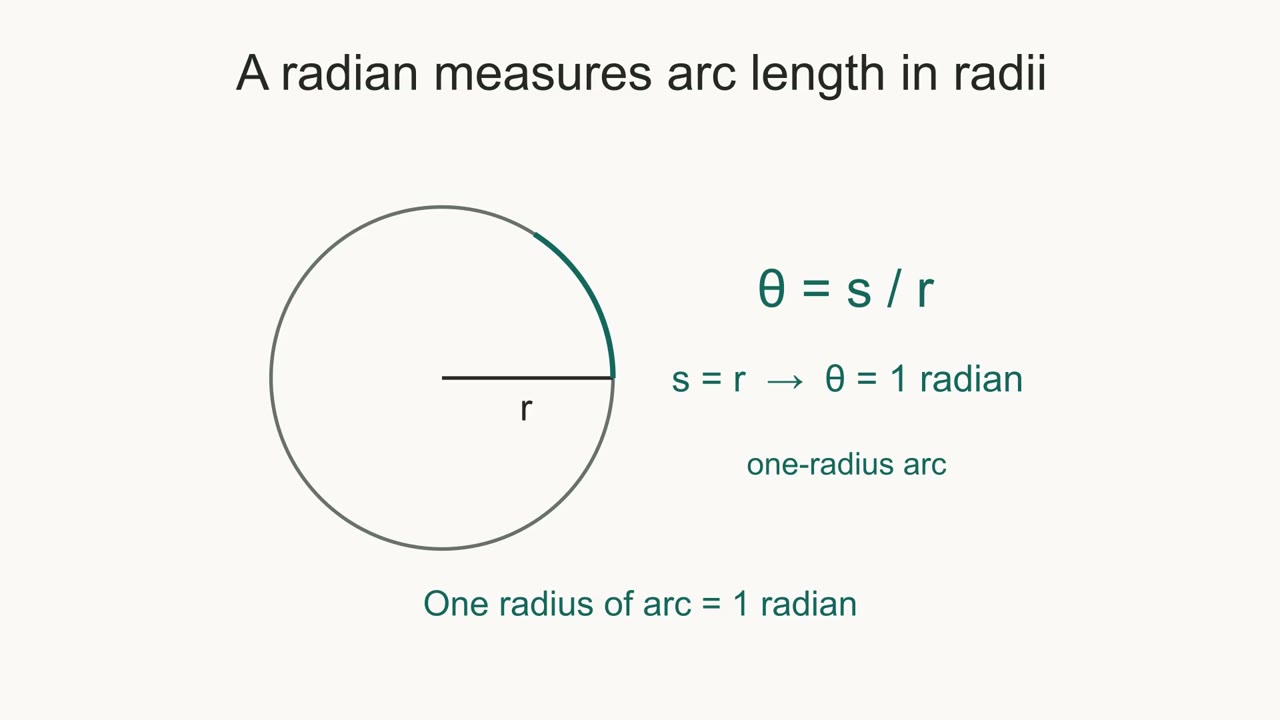
Measure a turn with the radius
Imagine taking a string exactly as long as a circle's radius. Lay it along the circle's edge. The angle swept out by that arc is one radian.
The definition is a ratio:
where is the arc length and is the radius. Equivalently, when is measured in radians.
Bigger circles give the same angle
Double the circle's radius and the matching arc doubles too. Their ratio stays unchanged. A radian therefore measures the turn, independent of the circle's size.
A full circumference is , so a full turn is
A half turn is radians, and a quarter turn is . These are the same turns as and ; we have changed the measuring unit.
Why this unit fits the geometry
With degrees, an arc-length formula needs a conversion factor. With radians, the relationship is simply “radius times angle.” This close connection to distance is why radians are the natural unit in many formulas involving circles, sine, cosine, and rates of rotation.
Wrap the string
On a circle of radius 3, an arc has length 6. What angle does it sweep out?
Answer: radians. This is less than a half turn, since .