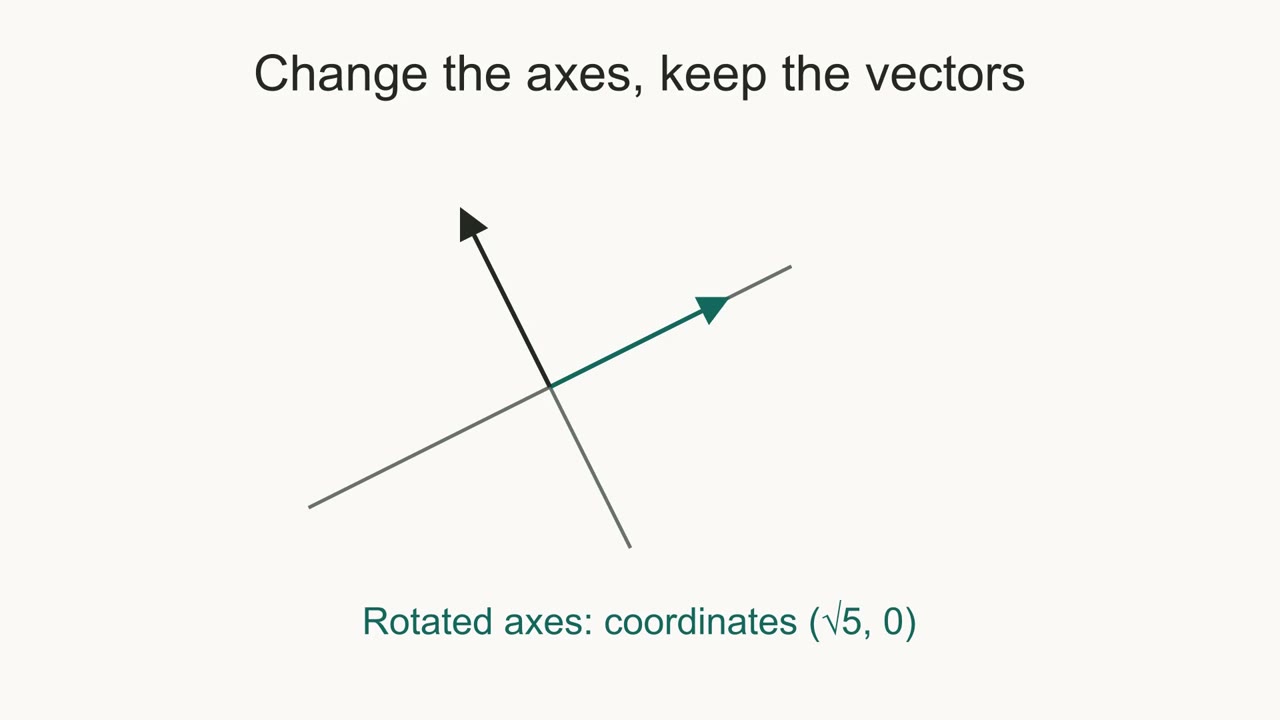
Move the rulers, keep the arrow
An arrow on a table stays put when you turn the grid drawn underneath it. What changes is how much of the arrow we describe as horizontal and vertical.
That is the central idea of a change of basis: the vector stays the same; its coordinates depend on the measuring directions.
Choose axes that fit the problem
Take and . Their dot product is , so the arrows are perpendicular. Both have length .
Use their directions as new unit axes:
In these coordinates, lies entirely along the first axis and entirely along the second:
The new zeros describe alignment, not lost information.
Read off the new coordinates
For perpendicular unit axes, each new coordinate is a dot product with one axis. If the columns of are , then
This orthonormal change preserves lengths and angles. A general basis still gives valid coordinates, but their ordinary sum of squares need not equal the vector's Euclidean squared length.
What became simpler?
Answer: Operations involving these two perpendicular directions can now use axis-aligned vectors. One common rotation can align both here because the original vectors are perpendicular.