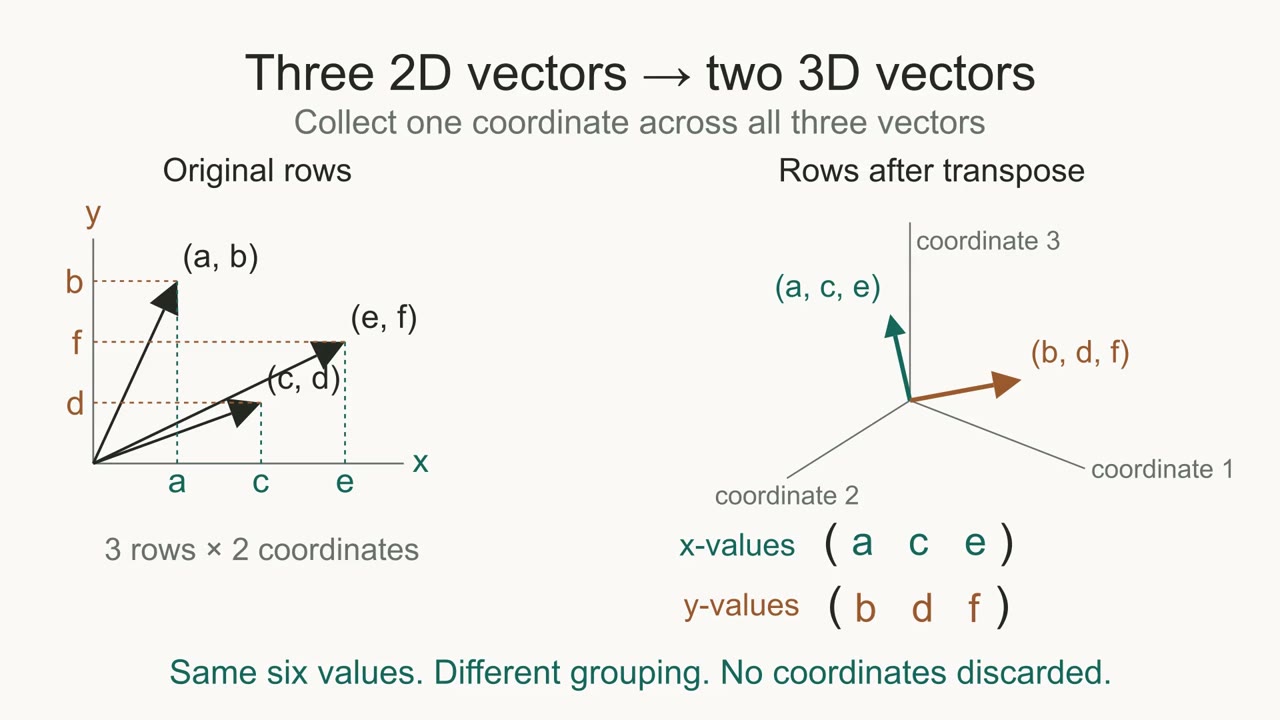
Regroup the same numbers
Start with three 2D vectors written as rows:
Each row can be drawn as a point in a plane: , , and . Now collect the first coordinate of every point into one row, and the second coordinate into another:
The new rows can be drawn as two points in 3D. These are two geometric interpretations of the same six numbers.
Follow one entry
The 4 began in row 2, column 2, and stays there. The 5 moves from row 3, column 1 to row 1, column 3. In general,
Transposing twice puts every entry back: .
Why the new picture matters
Suppose rows describe observations and columns describe features. Looking across a row shows one observation. Looking down a column shows how one feature varies across observations. Transposition switches which grouping is convenient to read or multiply.
Every entry remains available. This differs from a projection, which can discard coordinates and merge distinct inputs into one output.
Track a shape
What shape does a matrix have after transposition?
Answer: . It still contains 400 entries, with row and column roles exchanged.