Columns tell you where the axes go
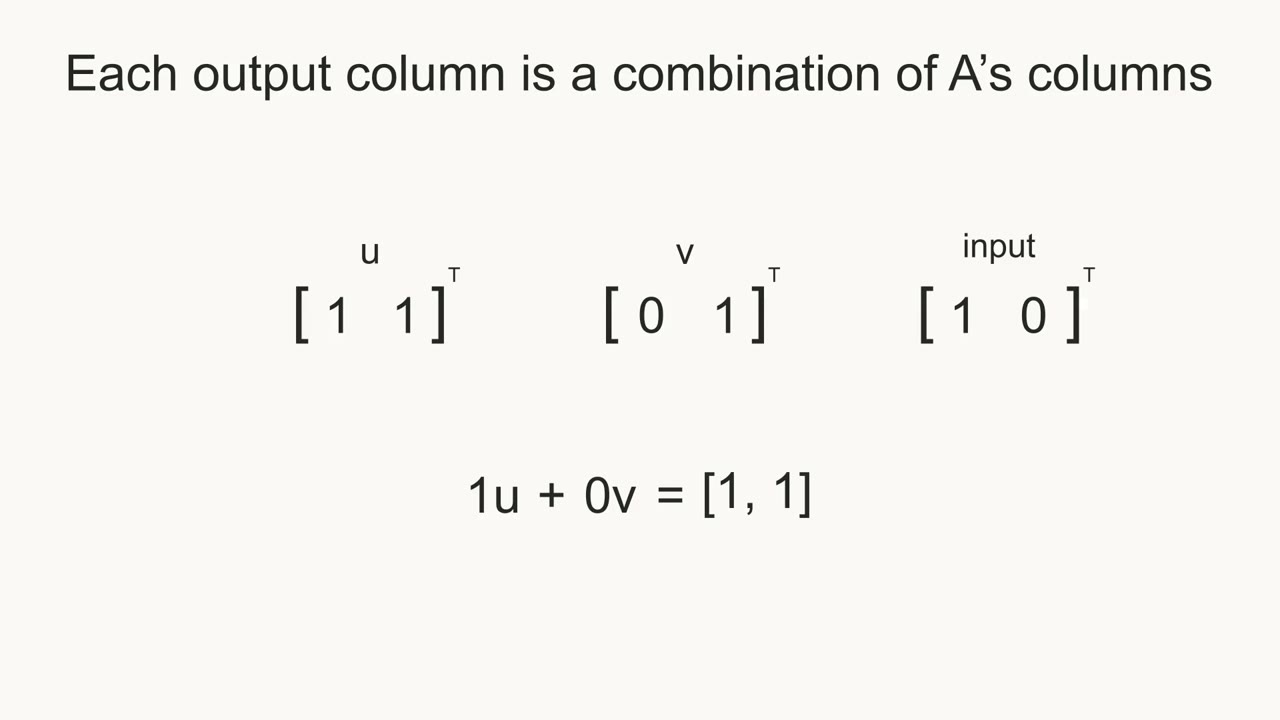
Suppose a matrix has columns and :
Apply it to the first coordinate direction, , and you get . Apply it to , and you get . The columns record where these two basic directions land.
Build every other output from those two arrows
The input means two steps along the first direction and three along the second. Linearity sends it to two copies of plus three copies of :
This is the column-combination view of matrix multiplication. The input coordinates supply coefficients; the matrix columns supply the arrows to combine.
Connect it to row–column arithmetic
The first output coordinate is . The second is . We have obtained the same answer by organizing the arithmetic differently.
The geometric view explains the whole transformation. Here the first axis tilts upward while the second stays fixed: the grid shears. A straight line of inputs still maps to a line or a point, and the origin stays at the origin.
Choose the coefficients
Which input returns exactly ?
Answer: , because . This is why the second column describes the image of the second coordinate direction.